ParaDEVS: Changing the Game in Simulation Technology with Accelerated Decision Paratemporal Simulation,
1000× Faster Than Monte Carlo
Monte Carlo simulations have been a common way to model uncertainties, but they come with problems—they’re slow, rigid, expensive, and not very flexible. Paratemporal DEVS (ParaDEVS) technology is here to change all that with a smarter and faster way to simulate complex systems.
Here’s how ParaDEVS makes a difference:
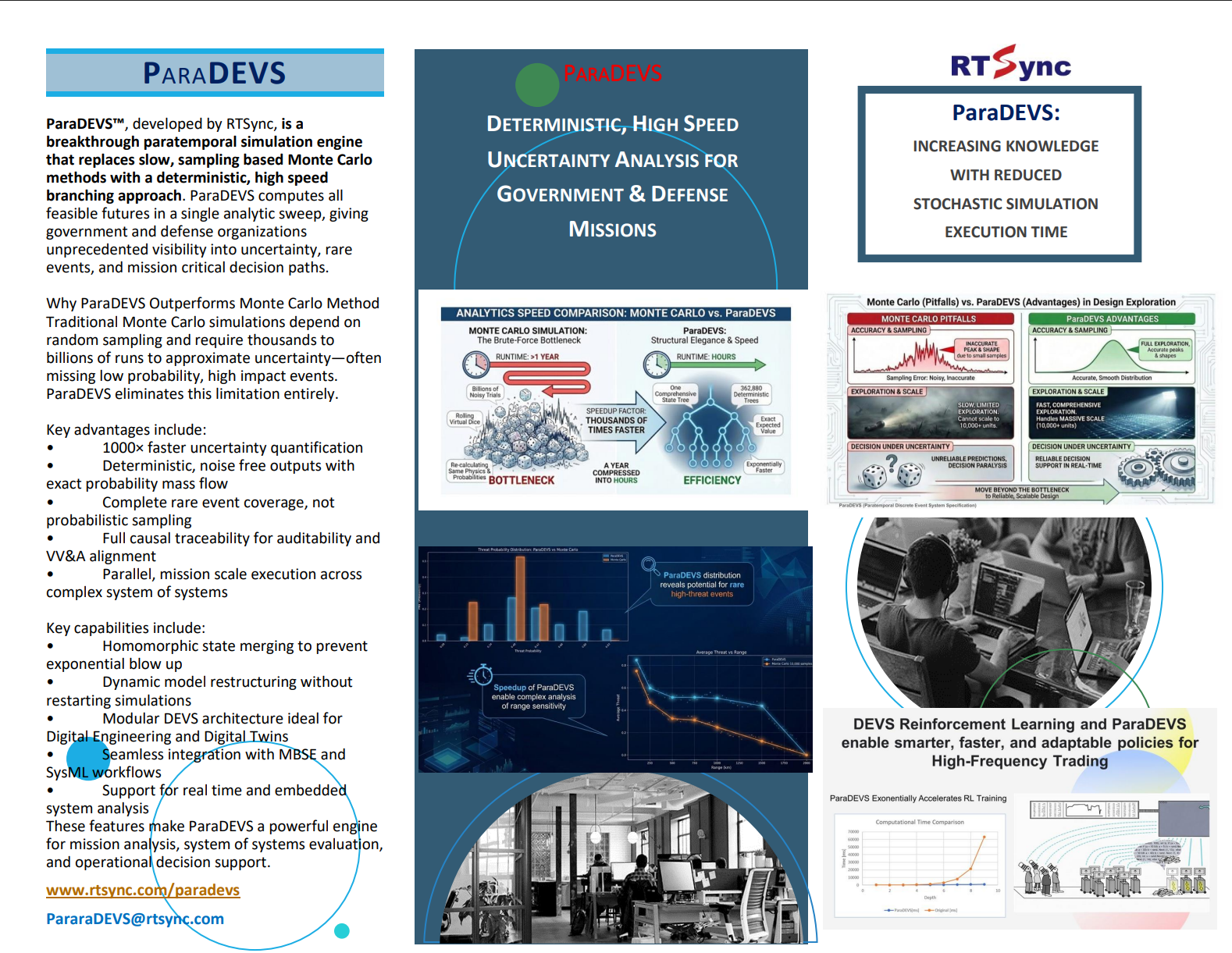
Comparison: ParaDEVS vs. Monte Carlo Simulation
Overview of Each Approach
ParaDEVS (Paratemporal Discrete Event System Specification)
- A high-performance stochastic simulation method designed for complex systems.
- Uses tree expansion rather than random sampling, leading to faster and more accurate results.
- Allows dynamic model adjustments during runtime without restarting the simulation.
- Integrates well with AI and machine learning for enhanced decision-making.
- Used in military simulations, stock market analysis, and rare event modeling.
Monte Carlo Simulation
- A probabilistic method that relies on random sampling to estimate outcomes.
- Often used for risk assessment, financial modeling, and uncertainty analysis.
- Can be computationally expensive, requiring a large number of iterations for accuracy.
- Works well for static models but lacks flexibility in dynamic system adjustments.
Key Differences
| Feature | ParaDEVS | Monte Carlo Simulation |
|---|---|---|
| Speed | Faster (Minutes/Hours) | Slower (Can take years for complex models) |
| Accuracy | Higher (tree expansion method) | Lower (random sampling introduces variability) |
| Flexibility | Can adjust model structure dynamically | Requires restarting for changes |
| Computational Efficiency | Optimized for large-scale simulations | Can be resource-intensive |
| Integration with AI | Seamlessly integrates with AI & ML | Limited AI integration |
| Use Cases | Military strategy, stock market analysis, rare event modeling | Financial risk analysis, engineering simulations, uncertainty modeling |
Recommendation: Which One is Better?
For organizations using simulation for high-stakes decisions, traditional Monte Carlo methods can be unreliable bottlenecks. They are often slow, computationally intensive, and limited by the statistical nature of random sampling. Even with significant compute resources, multiple independent sequential simulations may miss the “black swan” events critical to risk assessment. ParaDEVS™ addresses these limitations through a systematic, deterministic, branching analysis that guarantees results with mission-critical reliability. The result is comprehensive rare-event coverage and uncertainty reduction achieved in minutes, rather than the hours or days required by traditional tools.
ParaDEVS DEMO Videos
ParaDEVS vs. Monte Carlo Baseball Comparison
ParaDEVS represents a breakthrough in stochastic simulation with integrated uncertainty quantification. Comparison of Speed between ParaDEVS and Monte Carlo simulation using Baseball Lineup example ParaDEVS (Paratemporal DEVS) is a high-performance extension of the DEVS (Discrete Event System Specification) formalism designed for stochastic simulation. Instead of relying on repeated random sampling like traditional Monte Carlo methods, ParaDEVS uses tree-based expansion to model probabilistic
DEVS Reinforcement Learning and ParaDEVS Video
DEVS Reinforcement Learning and ParaDEVS enable smarter, faster, and adaptable policies for High-Frequency Trading
Beyond Monte Carlo: ParaDEVS Delivers Faster, Certain, High-Stakes Decisions in missile defense
ParaDEVS is a revolutionary stochastic simulation method that replaces Monte Carlo’s slow, probabilistic guesswork with deterministic clarity for military strategy.
Faster: Achieves a massive real-time speedup using parallel state tree expansion and homomorphic merging, delivering “total knowledge” in minutes instead of days.
Certain: Provides 100% visibility by exploring every possibility for the mathematically absolute truth, eliminating Monte Carlo’s noisy, error-prone sampling.
High-Stakes Decisions: Enables commanders to instantly compare strategies and act on stable trends immediately, transforming analysis into a fast, confidence-building decision process.
ParaDEVS: Deciding with Certainty in Space Domain Awareness – Rendezvous and Proximity Obs (RPO)
ParaDEVS is a breakthrough system for Space Domain Awareness, particularly for time-critical Rendezvous and Proximity Observations (RPO).
High Performance Stochastic Simulation
Faster Simulations
ParaDEVS can complete simulations in minutes or hours, compared to the years Monte Carlo might take for complicated models.
Flexibility
It allows changes to the model’s structure—like adjusting the behavior or layout—while the simulation is running. No need to restart!
More Accurate Results
Instead of relying on random sampling, ParaDEVS uses a smarter tree expansion approach that leads to quicker and more accurate outcomes.
Works with Everything
ParaDEVS connects smoothly with tools like AI and machine learning, making it perfect for industries with big, complex systems to model.
Powerful and Affordable
Unlike traditional tools that are pricey and restrictive, ParaDEVS offers powerful cost-effective simulation software.
ParaDEVS Application Examples
Decision Trees (Baseball Game Strategy)
Decision trees help simulate multi-choice scenarios with different probabilities. ParaDEVS efficiently maps out all possible choices, ensuring the best strategy emerges. For example, in a baseball game, each batter has different possible outcomes (hit, strikeout, walk, etc.). Using ParaDEVS, we can simulate all batting lineup combinations to find the best order for a team to score the most runs. Interestingly, Major League Baseball (MLB) data and ParaDEVS simulations show that the best home run hitter should ideally bat 4th in the lineup for maximum impact.
Systems Working in Series & Parallel (Kill Chains & Satellite Networks)
Many complex systems operate either in sequence (one step after another) or in parallel(multiple things happening at once). Military Command & Control (C2) systems, such as Kill Chains, depend on speed and efficiency to detect and neutralize threats quickly. ParaDEVS helps simulate and optimize these processes, allowing decision-makers to identify bottlenecks and improve performance before implementation.
Rare & Critical Events (Military Campaign Simulations)
Some military models group complex calculations into simplified estimates—which works for general predictions but misses important rare events that could change outcomes. Low-probability events—such as unexpected enemy movements or technological failures—can have a huge impact if they occur in sequence. ParaDEVS helps focus on these rare occurrences, providing a more detailed view of potential risks and unexpected outcomes that traditional models often overlook.
Stock Market & Investment Decisions (AI-Assisted Trading)
Markets are unpredictable, and investors rely on past data to make smart decisions. ParaDEVS uses Reinforcement Learning, a type of AI, to analyze past stock market trends and suggest optimal trading actions—whether to buy, sell, or hold stocks. Byrunning simulations, investors can forecast potential profits and minimize financial risks.
Chemical Reactions & Scientific Simulations
Many natural scientific processes, like chemical reactions, happen at random intervals and are modeled using complex mathematical equations. For example, the formation of a dimer molecule (two molecules joining together) follows unpredictable reaction times. ParaDEVS helps simulate these reactions more precisely, offering results that align with well-known scientific models while improving accuracy.
ParaDEVS MORS Conference Slides
ParaDEVS Journal Paper
Zeigler, B. P. (2024). Discrete event systems theory for fast stochastic simulation via tree expansion. Systems Journal.
FAQs
Please reach us at paradevs@rtsync.com if you cannot find an answer to your question.
How does ParaDEVS differ from Monte Carlo?
Monte Carlo samples outcomes randomly and often misses rare events. ParaDEVS evaluates all branches simultaneously, ensuring complete visibility.
Can ParaDEVS support mission-thread analysis?
Yes. ParaDEVS produces scenario trees and outcome distributions that align directly with UDH mission‑thread structures.
Does ParaDEVS support uncertainty quantification?
Yes. ParaDEVS generates EF‑aligned uncertainty artifacts suitable for UDH decision‑support workflows.
Is ParaDEVS compatible with DEVS-based MBSE tools?
Yes. ParaDEVS is built on the DEVS formalism and integrates with DEVS modeling environments.
What decisions are you currently facing where better uncertainty analysis could genuinely improve your outcome?
ParaDEVS targets decisions involving many possible alternative scenarios with uneven payoffs, where conventional methods lack the modeling. simulation, and computational power needed.
Simulation’s key value lies in how its uncertainty analysis helps modelers grasp both the major causal factors and the myriad of unknowns manifest in real decisions. In fact, we presented a tutorial at a MORS Conference that directly addresses the kinds of issues being raised. The tutorial, “Increasing Knowledge with Reduced Stochastic Simulation Execution Time –ParaTemporal Simulation using Tree Expansion”, is available here.
The tutorial includes several application sections that offer model formulations and examples of insights derived from them. Such examples consider occurrence patterns of low-probability events, critical events, and chained events. These are precisely the kinds of scenarios where model development and simulation output can shift thinking and improve outcomes. .
The ParaDEVS framework emphasizes building models that provide knowledge at increasing levels of resolution, while minimizing development cost and execution time. Its methodology, especially the tree‑expansion mechanism, is built around intelligent, progressive refinement. Instead of simulating everything uniformly, ParaDEVS encourages selective attention to the uncertainties that influence strategic decisions. The methodology aims to constrain tree growth (and critical execution time) by minimizing the creation of nodes that duplicate system state information already discovered.
A major strength of ParaDEVS is its insistence on explicit structure. Every model component has defined interfaces, causal flows, and temporal semantics. This forces clarity about which uncertainties matter and how they propagate through the system. This discipline also transforms the model into a transparent decision artifact leaving a traceable record of which uncertainties were considered, why certain branches were expanded, and how assumptions shaped the evaluation. In addition to producing noise free outcome distributions, ParaDEVS reveals which uncertainties dominate expected value, which branches justify deeper modeling, and where additional detail would be wasted effort.
Because ParaDEVS models are modular and hierarchical, you can evaluate alternative strategies under identical uncertainty streams. This makes divergences between choices visible and quantifiable; the model becomes a living tool that users can interrogate: What happens if this assumption changes? What if we expand this branch? ParaDEVS is designed to answer those questions in a disciplined, reproducible way.
In sum, the combination of modularity, explicit structure, targeted refinement, and repeatability makes ParaDEVS well suited for embedding uncertainty analysis into strategic choices. It scales from basic decision trees to complex tree expansions, providing a computational framework that evolves with user expertise and analytic demands.
UDH Integration for ParaDEVS
ParaDEVS and the Unified Data Hub (UDH)
ParaDEVS is fully compatible with the Unified Data Hub (UDH) knowledge and capability model. Its paratemporal simulation engine produces structured, traceable, and machine‑readable outputs that align with UDH’s mission‑thread, uncertainty, and decision‑support frameworks. ParaDEVS enables UDH users to explore complete branching scenarios, quantify uncertainty, and evaluate rare‑event outcomes that traditional Monte Carlo methods often miss. ParaDEVS integrates into UDH as a discoverable capability, a simulation service, and a structured knowledge source.
UDH‑Aligned Overview of ParaDEVS
ParaDEVS is a high‑performance stochastic simulation engine based on the DEVS (Discrete Event System Specification) formalism. It evaluates all possible temporal branches of a model in a unified decision tree, enabling complete visibility into system behavior under uncertainty. This approach is ideal for high‑branching, long‑running, or rare‑event‑sensitive mission scenarios.
ParaDEVS supports UDH workflows by providing:
- A unified scenario tree for mission‑thread analysis
- Full outcome distributions for decision support
- Rare‑event detection and characterization
- EF‑aligned uncertainty quantification
- Traceable, reproducible simulation artifacts
Capabilities in UDH Terms
ParaDEVS provides the following UDH‑aligned capabilities:
- Branching Temporal Simulation Evaluates multiple temporal paths concurrently, producing a complete scenario tree.
- Rare‑Event Outcome Identification Captures low‑probability, high‑impact events that Monte Carlo sampling often misses.
- Mission‑Thread Evaluation Supports Space Domain Awareness, RPO characterization, logistics, and other mission‑critical workflows.
- Uncertainty Quantification Generates EF‑aligned uncertainty artifacts for decision‑makers.
- DEVS‑Based Model Execution Integrates with model‑based engineering workflows using the DEVS formalism.
Glossary (UDH‑Mapped Terms)
- Paratemporal Simulation — Evaluation of multiple temporal branches simultaneously; UDH term: branching temporal scenario evaluation.
- Scenario Tree — Unified branching structure representing all possible outcomes; UDH term: mission‑thread scenario tree.
- Rare‑Event Branch — Low‑probability, high‑impact outcome; UDH term: extreme‑tail scenario.
- Outcome Distribution — Statistical summary of all branches; UDH term: mission outcome distribution.
- Uncertainty Artifact — Structured representation of uncertainty; UDH term: EF‑aligned uncertainty output.
- DEVS Model — Formal event‑driven system model; UDH term: event‑driven system representation.
Mission‑Thread Applications
ParaDEVS supports mission‑thread analysis across multiple domains:
- Space Domain Awareness (SDA)
ParaDEVS evaluates high‑branching RPO scenarios, including detection, maneuvering, and environmental perturbations. The unified scenario tree reveals rare‑event branches such as collision risks or unexpected proximity behaviors.
- Logistics and Readiness
ParaDEVS models supply chain disruptions, transportation delays, and resource allocation decisions, producing outcome distributions that support readiness assessments.
- Complex System-of-Systems Analysis
ParaDEVS handles long‑running, multi‑actor simulations where branching behavior grows exponentially.
ParaDEVS in UDH Ask Copilot
ParaDEVS is optimized for discovery and reasoning within UDH Ask Copilot. Ask Copilot can:
- Explain ParaDEVS concepts in UDH vocabulary
- Retrieve ParaDEVS capabilities and definitions
- Answer technical questions about paratemporal simulation
- Provide mission‑thread examples using ParaDEVS
- Summarize uncertainty outputs
- Compare ParaDEVS to Monte Carlo methods
- Guide users on how to run ParaDEVS‑based workflows
This makes ParaDEVS a first‑class simulation capability within the UDH ecosystem.
Simulation Outputs for UDH
ParaDEVS produces structured outputs that align with UDH ingestion formats:
- Scenario Tree (JSON) Complete branching structure of all evaluated outcomes.
- Outcome Distribution (CSV/JSON) Statistical summary of mission‑level results.
- Uncertainty Artifact (EF‑Aligned) Parameter uncertainty, model uncertainty, branch‑specific uncertainty, and tail‑risk identification.
- Traceability Log Full record of model versions, parameters, and branching decisions.
API Integration for UDH Workflows
ParaDEVS can be exposed as a callable simulation service within UDH environments. Supported operations include:
- Running a paratemporal simulation
- Generating a scenario tree
- Producing uncertainty quantification outputs
- Returning mission‑thread‑aligned distributions
These services can be integrated into UDH pipelines, dashboards, or automated workflows.